Redesigning Enterprise Software: From 'Serving Humans' to 'Operating with AI'
Discover how Vietnamese SMEs can bridge the trust gap and overcome legacy integration debt to transition from passive software systems to autonomous, agentic AI operations.
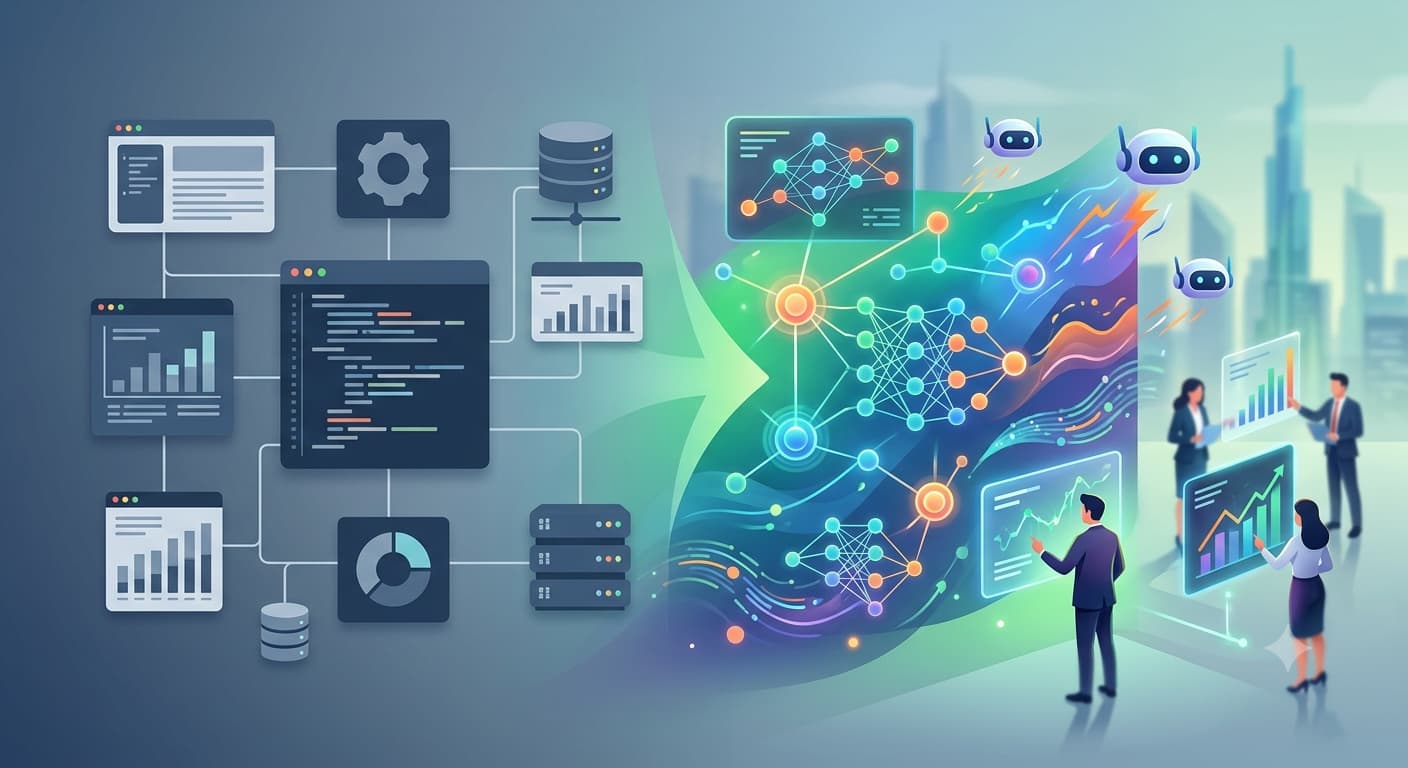
For decades, enterprise software has operated under a simple, unquestioned paradigm: systems serve humans. From legacy Enterprise Resource Planning (ERP) databases and Customer Relationship Management (CRM) platforms to basic accounting software, these tools have acted as digital filing cabinets. They require human beings to input data, click buttons, generate reports, and interpret results. The software itself is entirely passive, waiting silently for a human command. However, as we move deeper into the late 2020s, this paradigm is undergoing a fundamental shift. We are transitioning from an era where software merely 'serves humans' to one where businesses 'operate alongside AI' as collaborative partners. For small and medium enterprises (SMEs) in Vietnam, this shift is no longer a futuristic concept—it is an active operational reality that will define the competitive landscape of tomorrow.
The appetite for this technological evolution in Vietnam is remarkably high. According to Microsoft's Global AI Diffusion Report published in June 2026, Vietnam's AI adoption rate among the working-age population reached an impressive 26.5% in Q1 2026, up from 21.2% in the first half of 2025. This rapid rise positions Vietnam second in Southeast Asia, trailing only Singapore at 63.4%. This statistic indicates that the Vietnamese workforce is highly receptive, digitally literate, and eager to integrate AI into their daily routines. Yet, a deeper look at how enterprises actually deploy these technologies reveals a stark contrast between personal adoption and deep corporate integration.
According to the AWS and Strand Partners 'Unlocking Vietnam's AI Potential' study released in September 2025, while 18% of Vietnamese enterprises have officially adopted some form of AI, only a tiny fraction—just 9%—have reached a comprehensive transformation stage where AI is deeply integrated as a core driver for product development and business models. Conversely, a staggering 74% of these adopting enterprises still use AI exclusively for basic, human-driven operational tasks, such as drafting emails, generating basic copy, or summarizing PDF documents. To truly unlock competitive advantages, Vietnamese businesses must move past these basic use cases and begin rebuilding their software architecture around autonomous, collaborative AI workflows.
The Rise of Agentic AI: Moving Beyond Simple Prompts
The key to transitioning from 'serving humans' to 'operating with AI' lies in a concept known as Agentic AI. Unlike traditional generative AI tools that require constant human prompting to produce a single output, Agentic AI refers to autonomous systems that can set their own sub-goals, analyze complex environments, and execute multi-step workflows independently to achieve a broad business objective. Instead of a human employee acting as the bridge between different software tools, the AI agent acts as the coordinator, orchestrating tasks across multiple platforms.
The business community in Southeast Asia is highly aware of this potential. The 'AI in Southeast Asia' report published in September 2026 by McKinsey, EDB, and Tech in Asia revealed that 90% of organizations in the region are 'ready to experiment' with Agentic AI. In a practical business context, this means moving away from a system where an employee must manually check inventory levels, predict shortages, draft an email to a supplier, and wait for approval. Instead, an autonomous agent monitors real-time inventory trends, correlates them with seasonal sales data, automatically negotiates pricing with supplier APIs, and presents a fully finalized purchase order to a manager for a single-click sign-off. The software is no longer a passive tool; it is an active operational teammate.
The Twin Roadblocks: The Trust Deficit and Integration Debt
Despite the immense promise of Agentic AI, Vietnamese SMEs face two massive hurdles that prevent them from fully transitioning to an autonomous operational model. The first hurdle is cultural and psychological: a profound lack of trust in AI-generated outputs. According to ITviec's 'Vietnam AI Adoption Status and IT Hiring Insight 2025' report, only 5.4% of Vietnamese companies place high enough trust in AI-generated outputs to use them with minimal human checks. This persistent trust gap acts as a severe bottleneck. If managers feel compelled to review, edit, and double-check every single calculation, email, or report generated by an AI, the operational efficiency gains drop to near zero. Businesses remain stuck in a loop of constant human supervision, unable to scale their operations.
The second hurdle is technical and structural: what industry experts call 'integration debt.' As highlighted by regional technology integrator SotaTek in 2026, the transition to AI-agentic enterprise software in Southeast Asia is severely bottlenecked by legacy infrastructure. Decades-old on-premise servers, fragmented local databases, and outdated, custom-built ERP systems are completely unable to support the real-time, unified data pipelines that autonomous AI agents require to make accurate decisions. If an AI agent cannot access real-time logistics data because it is locked in an offline spreadsheet on a warehouse computer, the agent cannot function. Consequently, many promising AI initiatives remain permanently stuck in the pilot or proof-of-concept phase, unable to scale across the organization.
A Practical Blueprint for Vietnamese SMEs to Operate with AI
To overcome these challenges and successfully transition from human-centric software to collaborative, AI-driven operations, Vietnamese SMEs must adopt a structured, step-by-step approach. This transformation does not require discarding all existing legacy systems overnight; rather, it requires strategic modernization and the implementation of clear operational guardrails.
- Consolidate Data Silos: Address integration debt by migrating critical business data from isolated, on-premise spreadsheets to secure, cloud-based data warehouses. AI agents require clean, unified, and real-time data to operate effectively.
- Implement 'Human-in-the-Loop' (HITL) Guardrails: Bridge the trust gap by designing workflows where the AI agent performs 90% of the heavy lifting, but leaves final approval to a human manager. This builds confidence over time while maintaining strict quality control.
- Start with High-Impact, Low-Risk Workflows: Avoid transforming core proprietary processes immediately. Instead, deploy AI agents in areas like automated customer support routing, routine invoice reconciliation, or basic inventory forecasting.
- Focus on API-First Software Selection: When purchasing new enterprise software, prioritize platforms that offer robust, open APIs. This ensures that future AI agents can easily communicate with and extract value from your software stack.
- Foster an AI-Collaborative Culture: Train employees to view AI not as a replacement, but as an operational assistant. Shift their roles from manual data entry operators to strategic system overseers.
Conclusion: Navigating the Future with Hanoi Byte
The transition from software that 'serves humans' to software that 'operates with AI' represents the next major frontier of digital transformation in Vietnam. While the technical and cultural challenges—such as integration debt and the trust gap—are real, the competitive risks of standing still are far greater. By taking a methodical approach to data consolidation, system integration, and trust-building, Vietnamese SMEs can position themselves at the forefront of this regional revolution. At Hanoi Byte, we specialize in helping local businesses navigate these complex technological transitions. Whether you need to modernize your legacy infrastructure, design secure AI integration pipelines, or build custom agentic workflows that drive real-world efficiency, our team of local digital experts is here to guide you. Contact Hanoi Byte today to schedule a consultation and take your first step toward true AI-driven operational excellence.