WordPress Core "XSS2Shell" Vulnerability (CVE-2026-64638): How a Simple Login Bug Leads to Full Server Takeover
The critical XSS2Shell vulnerability (CVE-2026-64638) in WordPress Core allows unauthenticated attackers to hijack administrator sessions and execute PHP code on the server.
Affected platforms
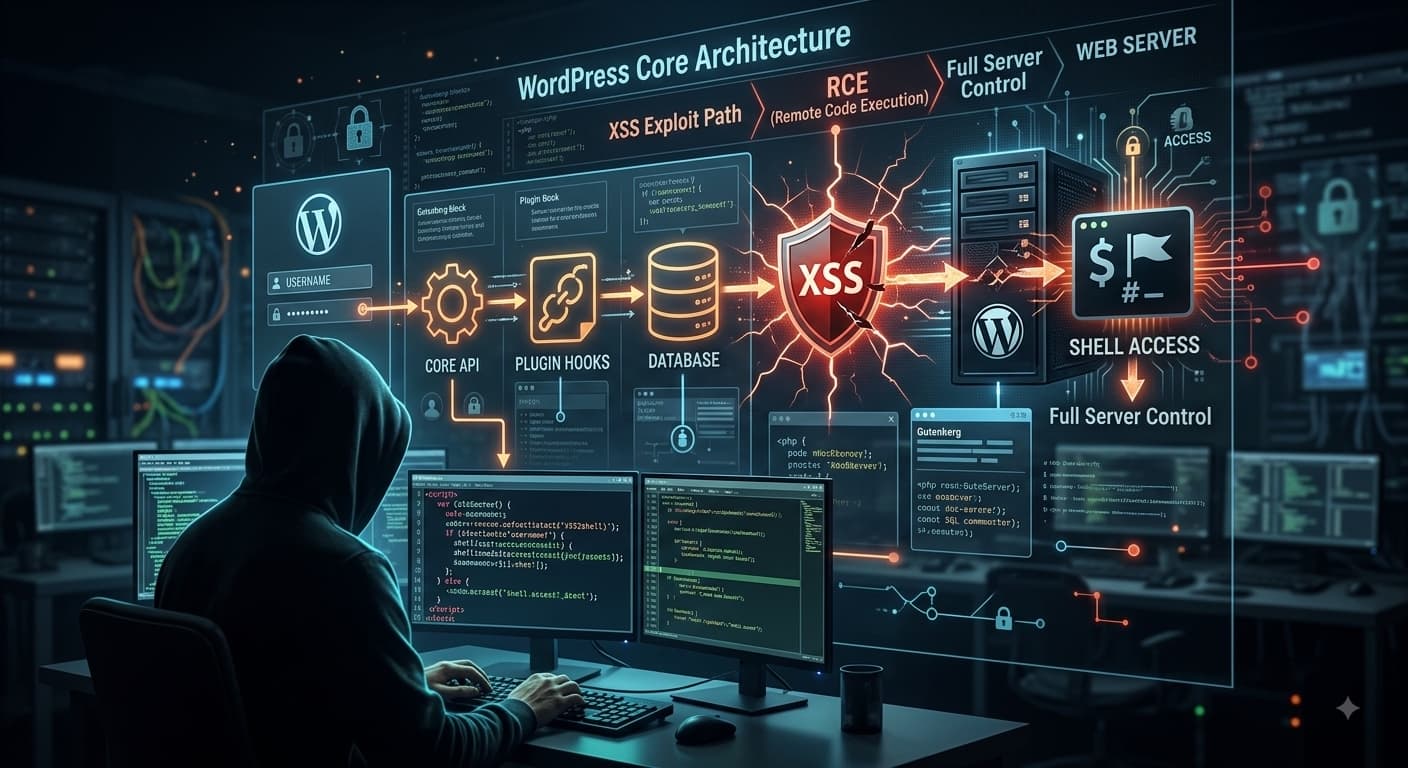
This week, the global cybersecurity community is closely monitoring a highly critical vulnerability discovered in the core code of WordPress. Dubbed "XSS2Shell" and tracked as CVE-2026-64638, this flaw carries a high severity CVSS score of 8.9. Crucially, this is not a vulnerability within a third-party plugin or theme; it resides directly within the default login handling mechanism of WordPress Core—the platform that powers over 40% of all websites globally. For business leaders, this represents a major warning sign that demands immediate attention to protect digital assets and customer trust.
Executive summary
- Core Platform Risk: CVE-2026-64638 (XSS2Shell) directly impacts WordPress Core versions 4.7 through 7.0.2.
- Sophisticated Attack Chain: An unauthenticated attacker can exploit a parser discrepancy on the login screen to execute malicious JavaScript (XSS) and eventually hijack a logged-in administrator's session.
- Severe Business Impact: The attack can escalate to Remote Code Execution (RCE), allowing attackers to upload malicious plugins, steal customer data, or deploy ransomware.
- Immediate Action Required: Businesses must update their WordPress installations to version 7.0.3 (or the latest 7.0.4) within the next 24 to 72 hours.
What happened?
Discovered by security researchers at pwn.ai, the XSS2Shell vulnerability was patched in the WordPress 7.0.3 emergency security release on August 6, 2026. The root cause of the vulnerability lies in a parser disagreement between two of WordPress's internal HTML sanitization functions when handling usernames on the login page. When a user enters an invalid username, WordPress displays that username back in an error message. Before rendering, this input is processed by two separate sanitizers. An attacker can craft a specific username containing whitespace that bypasses the first filter but is interpreted as a valid HTML element by the second. This allows the attacker to inject malicious HTML elements onto the login screen without needing any prior authentication.
How the attack works at a high level
While the initial entry point is a reflected Cross-Site Scripting (XSS) bug, the true danger lies in how the exploit chains multiple default WordPress features. If an administrator is tricked into visiting a malicious link (via social engineering), the injected HTML on the login page manipulates the default JavaScript loaded by WordPress. This technique, known as "DOM Clobbering," overrides critical system variables. The malicious script then silently generates a new "Application Password" under the administrator's session. Using this newly created credential, the attacker can authenticate REST API requests to upload a malicious PHP plugin, ultimately achieving full Remote Code Execution (RCE) and taking complete control of the web server.
Why this is a business risk
For modern enterprises, a website is far more than just a digital brochure; it is a vital business channel, a customer portal, and a gateway to internal databases. A vulnerability like XSS2Shell that leads to Remote Code Execution (RCE) poses catastrophic business risks. A successful compromise can result in prolonged operational downtime, massive data breaches violating compliance regulations, and severe reputational damage. Furthermore, attackers can leverage server control to deploy ransomware, destroy backups, or use the compromised infrastructure to launch secondary attacks, leading to devastating financial and legal consequences.
Other notable enterprise and CMS risks this week
In addition to XSS2Shell, this week has seen several other critical security developments. Following the 7.0.3 patch, WordPress released version 7.0.4 on August 12, 2026, to address an authenticated Remote Code Execution vulnerability involving malicious file uploads on systems using Imagick and Ghostscript. In the broader enterprise landscape, the U.S. Cybersecurity and Infrastructure Security Agency (CISA) added a critical SQL Injection vulnerability in the Metabase data analytics platform (CVE-2026-72898) and a Windows WinSock privilege escalation vulnerability (CVE-2026-68820) to its Known Exploited Vulnerabilities (KEV) catalog on August 11, 2026, signaling active real-world exploitation.
What businesses should do in the next 24–72 hours
- Update WordPress Immediately: Ensure all WordPress sites are updated to the latest version (7.0.3 or 7.0.4). If you run older versions, verify that the backported security patches have been successfully applied.
- Disable Application Passwords: If your website does not rely on Application Passwords for external API integrations, disable this feature entirely to break the XSS2Shell attack chain.
- Audit Web Server Logs: Review your access logs for unusual requests targeting the login page (wp-login.php) or unauthorized creation of application passwords.
- Deploy Web Application Firewall (WAF) Rules: Confirm that your WAF (e.g., Cloudflare, Imperva) has active rules to detect and block the specific payload signatures of the XSS2Shell exploit at the network edge.
Long-term lessons for CMS and digital infrastructure security
The XSS2Shell vulnerability demonstrates that modern cyber threats rarely rely on a single, massive security flaw. Instead, attackers chain multiple minor, seemingly low-risk issues together to achieve devastating results. To build long-term resilience, business leaders must shift from a reactive security posture to a proactive one. This requires establishing a robust, automated patch management process, adopting a Zero Trust architecture, implementing continuous 24/7 security monitoring, and maintaining a well-rehearsed incident response plan. Ultimately, cybersecurity must be treated as a core component of corporate risk management, not just an IT department checklist.
How Hanoi Byte can help
If your business relies on WordPress, a custom CMS, or cloud-based digital infrastructure, Hanoi Byte can help you assess risks, modernize your systems, and build a practical security and maintenance roadmap. As a trusted digital transformation partner, we specialize in cloud optimization, custom software development, and building secure, resilient digital operations tailored to your business scale. Contact Hanoi Byte today to start a conversation about securing your digital assets and accelerating your digital transformation journey.