Vietnam's First Applied AI Lab: A Catalyst for Business Innovation
The launch of Vietnam's first Applied AI Lab marks a significant step towards accelerating AI adoption and innovation for local businesses, especially SMEs.
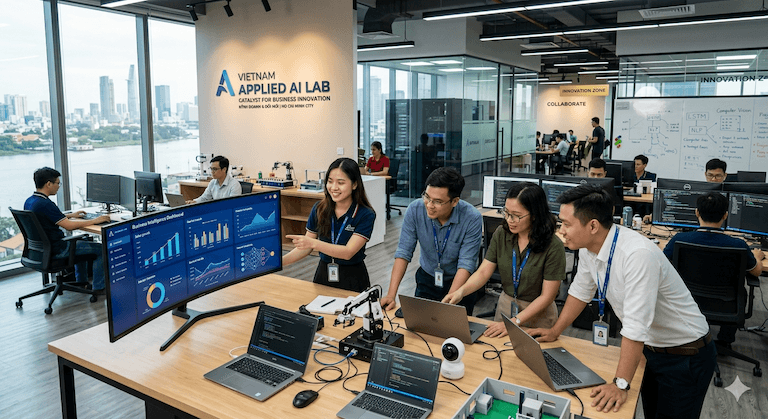
The landscape of technology in Vietnam is continuously evolving, and a momentous development on May 4, 2026, underscored this progress: the launch of the first Applied AI Lab in the country. This groundbreaking initiative is a strategic partnership between Google Labs' AI Futures Fund and Saigon AI Hub (SAIH), co-founded by VNG Group and Vietnam National University Ho Chi Minh City (VNUHCM). This collaboration is poised to become a critical engine for driving practical AI solutions and fostering a robust ecosystem for artificial intelligence within Vietnam, offering unprecedented opportunities for businesses, particularly Small and Medium-sized Enterprises (SMEs).
The Accelerating Pace of AI Adoption in Vietnam
Vietnamese businesses have already demonstrated a strong appetite for AI. Recent data highlights that over 89% of Vietnamese businesses have integrated AI into their marketing strategies, with a significant 78% reporting medium to high levels of integration. This proactive adoption is yielding tangible benefits: approximately 61% of businesses utilizing AI have reported expected improvements in operations and revenue growth, while 58% anticipate or have achieved cost savings. The year 2025 alone saw the adoption rate of AI among Vietnamese businesses surge by 39% year-on-year, indicating a clear trajectory towards a more AI-driven economy. For SMEs, this trend is even more pronounced, with nearly 44% identifying AI as their top technology investment, double the figure from the previous year. AI and generative AI are projected to contribute up to $120 billion to Southeast Asia's GDP by 2027, with the regional AI market expected to grow from USD 5,066.7 million in 2025 to USD 19,576.0 million by 2034.
The impact of AI is visible across various sectors. In customer service, AI applications now handle around 70% of common inquiries. Leading banks are improving business performance by 27–35% through AI, significantly cutting fraud cases by up to 90%. Furthermore, businesses in the e-commerce sector applying AI can increase productivity by 25–40% in sales and personalize customer experiences to boost revenue by 5–10%.
Addressing the Hurdles to Widespread AI Integration
Despite the undeniable potential and enthusiasm, the path to full AI integration in Vietnam is not without its challenges. The nation possesses strong AI talent, but a significant hurdle has been the lack of resources and supportive conditions for researchers to fully develop their capabilities. Businesses, especially SMEs, encounter specific difficulties:
- Skills Shortages: A scarcity of skilled AI professionals makes implementation difficult.
- Fragmented Data: Disconnected public sector datasets and limited data sharing hinder large-scale AI solutions.
- Integration Issues: Challenges in integrating complex AI tools with existing legacy systems.
- Limited Capital: SMEs often lack the financial resources for significant AI investments.
- Undocumented Knowledge: Expert knowledge is often not formalized, making it hard for AI systems to learn.
- Policy Ambiguity: Unclear policies and mechanisms create uncertainty for businesses adopting AI.
- Cost and Security Concerns: High implementation costs and concerns about data privacy and security remain major obstacles.
Moreover, while the Total Addressable Market (TAM) for AI in Southeast Asia is expanding rapidly, actual implementation lags, suggesting a widening gap between potential and realization. Vietnam also receives significantly less venture capital investment in AI compared to more mature markets like Singapore, highlighting the need for more localized support structures.
The Applied AI Lab: A Solution-Oriented Approach
The Applied AI Lab is designed to directly address these challenges. By focusing on 'applied' AI, it aims to translate cutting-edge research into practical, deployable solutions tailored for the Vietnamese market. It will serve as a hub for: fostering local AI talent by providing necessary resources and infrastructure; developing industry-specific AI applications that cater to the unique needs of local businesses, particularly SMEs; and promoting collaboration between academia, industry, and government to streamline data sharing and policy development. This initiative will empower businesses to overcome technical barriers, access expert guidance, and implement AI solutions that drive real-world impact and sustainable growth.
The launch of Vietnam's first Applied AI Lab is more than just an academic milestone; it's a strategic investment in the nation's economic future. By nurturing local talent and focusing on practical applications, it promises to bridge the gap between AI potential and widespread implementation, ensuring that Vietnamese businesses, from startups to established enterprises, can leverage AI to innovate, compete, and thrive. At Hanoi Byte, we believe this lab will be instrumental in accelerating Vietnam's digital transformation journey. If your business is ready to explore how AI can drive your next wave of growth, contact Hanoi Byte today. We’re here to help you navigate the complexities and unlock the full potential of artificial intelligence.